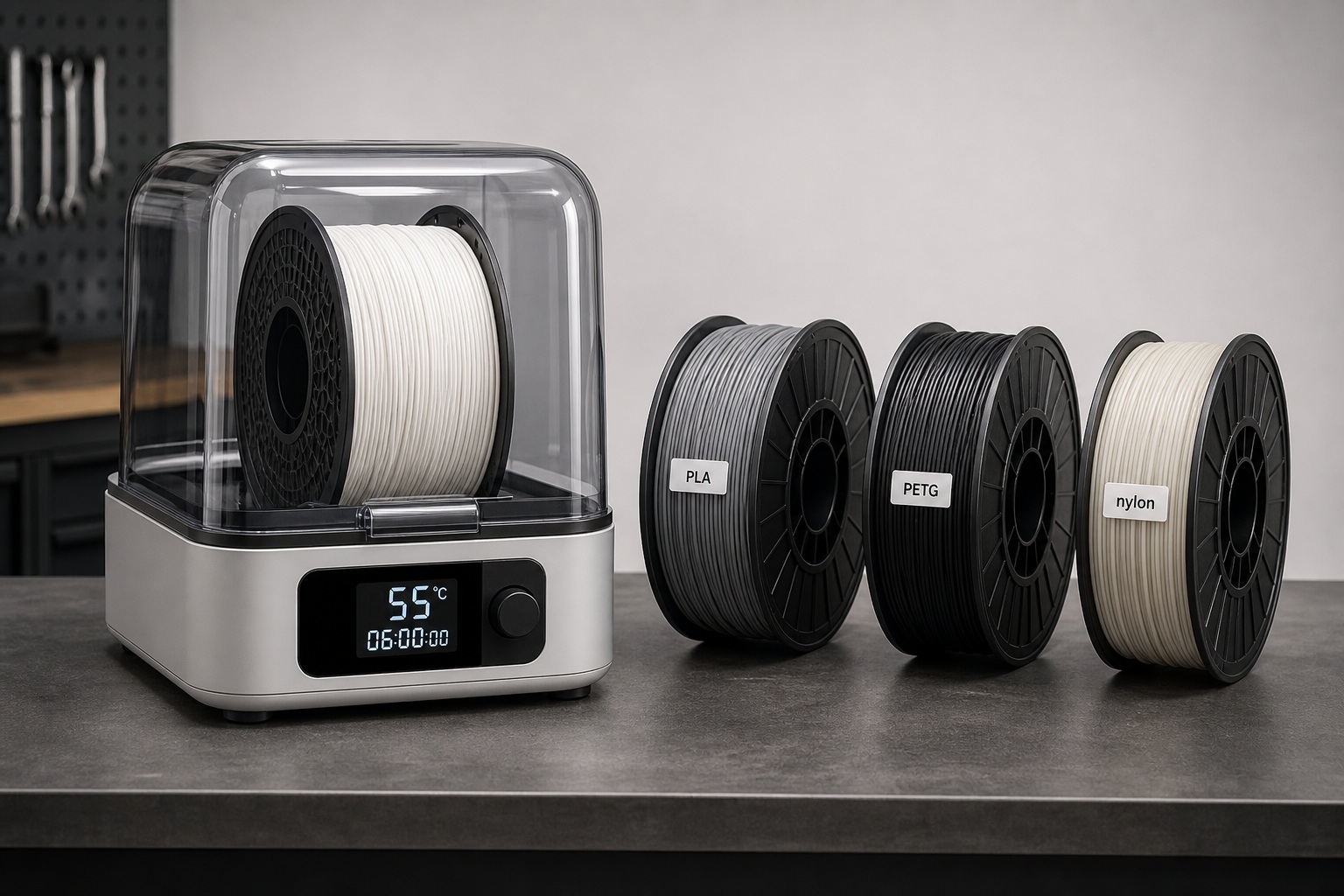
Filament dryer settings by material come down to two decisions: not a secret number you memorize for every plastic. How hot can you go before the spool softens? And how long do you run the cycle, based on how thirsty the material is? Set the temperature just below the point where the plastic softens, then run it long enough for how much water that material holds. The chart below gives safe starting numbers for every common filament. But if the spool or the manufacturer's datasheet lists its own figures, use those. Proprietary blends really do differ, and a published spec beats a general chart every time.
One clarification before the numbers, because it ruins more spools than anything else: these are drying temperatures, completely separate from the nozzle temperature you enter in your slicer. The two are unrelated. This guide covers hobby FDM filament on plastic or cardboard spools, dried in a dedicated filament dryer (a food dehydrator or oven works, with caveats). It stops applying to industrial high-temp polymers like PEEK and PEI, which need 120–150 °C equipment most people don't own.
What These Settings Control
These settings control the heat that pulls absorbed water back out of a spool: not the heat that melts and extrudes it. Filament drying means warming a roll enough to evaporate the moisture it soaked up from the air, then venting that moisture away with airflow. Wet plastic prints badly because the trapped water flashes to steam inside the hotend, blowing bubbles into the melt.
Read the chart as a starting point, not a commandment. Pick a value inside each range, lean toward the low end when you're unsure, and add time rather than crank the heat. Where a brand prints its own drying figure on the spool or datasheet, that number overrides the chart: Polymaker, Prusament, Bambu Lab, and eSun each publish values tuned to their specific formulation.
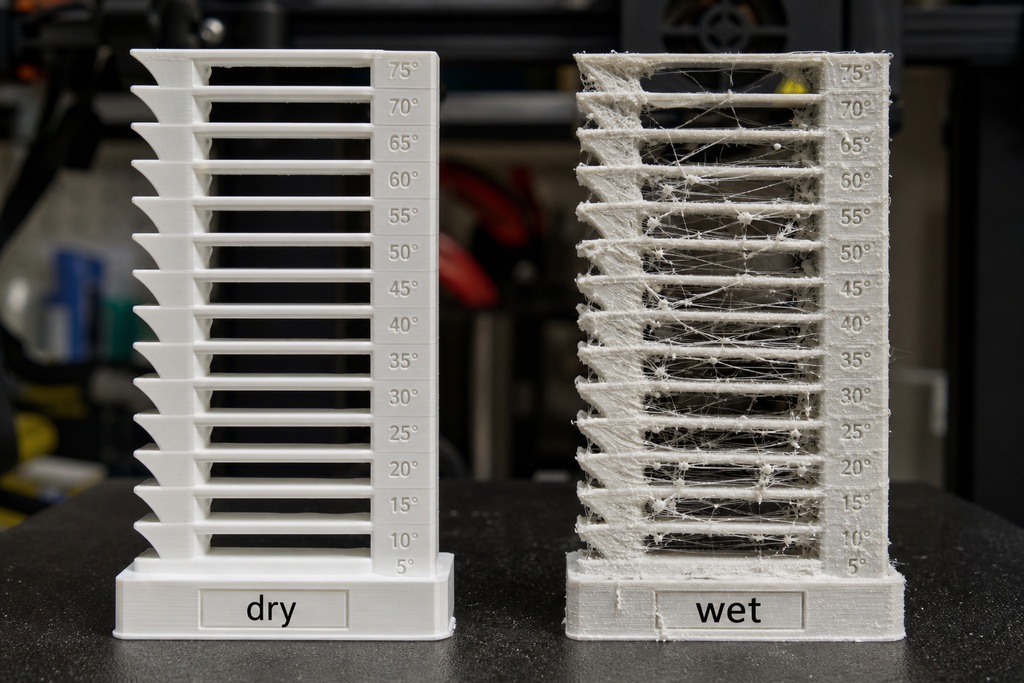
Filament Dryer Settings by Material: Quick Reference Table
Dry each material just below its softening point, for a time set by how much moisture it holds: this quick reference table gives safe starting numbers for every common filament. The materials shown as wide ranges (PETG, ABS, TPU, PC, HIPS) are exactly where reputable sources disagree most. For those, start at the low end of the temperature and add hours instead of degrees.
| Material | Dry temp (°C) | Dry temp (°F) | Time (hrs) | Moisture level | Notes |
|---|---|---|---|---|---|
| PLA | 40–50 | 104–122 | 4–6 | Low | Softens near 55–60 °C: stay conservative |
| PLA+ / filled / CF-PLA | 45–55 | 113–131 | 4–8 | Low–Medium | Filled grades hold more water; add time |
| PETG | 50–65 | 122–149 | 4–8 | Medium | High variance: start 55–60 °C |
| PCTG | 60–70 | 140–158 | 4–8 | Medium | Dried slightly hotter than PETG |
| ABS | 60–80 | 140–176 | 4–6 | Medium | High variance; 60 °C works if extended to 8–10 h |
| ASA | 60–80 | 140–176 | 4–6 | Medium | Like ABS; UV-stable |
| TPU / TPE | 40–60 | 104–140 | 4–8 | High | Keep low: excess heat embrittles it |
| Nylon (PA / PA6 / PA12) | 70–90 | 158–194 | 8–24 | Very high | PA6 thirstier than PA12 |
| Nylon CF / GF | 70–90 | 158–194 | 10–12+ | Very high | Fibers trap moisture |
| Polycarbonate (PC) | 70–90 | 158–194 | 6–12 | Very high | Needs a high-temp unit |
| PC blends | 65–80 | 149–176 | 6–10 | High | Lower than pure PC |
| PVA | 45–55 | 113–131 | 4–12 | Very high | Melts or gels if overheated |
| BVOH | 45–60 | 113–140 | 6–12 | Very high | Absorbs faster than model filament |
| HIPS | 55–80 | 131–176 | 4–6 | Medium | High variance |
| PP | 55–65 | 131–149 | 4–8 | Low–Medium | Sensitivity varies by formulation |
| PVB | 45–55 | 113–131 | 4–6 | Medium | For polished prints |
| PMMA (acrylic) | 65–75 | 149–167 | 4–8 | Medium | Keep dry to avoid bubbles |
| Wood-fill | 40–45 | 104–113 | 6+ | Medium–High | Match PLA base, add time |
| CF / GF filled | Match base | Match base | +1.5–2× | Varies | Fibers hold water; low end of base temp |
| PEEK / PEKK / PEI / PPS | 120–150 | 248–302 | 4–12 | , | Industrial only, not consumer dryers |
Quick Default Settings
No numbers printed on the spool and no time to look them up? These single-value defaults sit in the safe middle of each range:
- PLA: 45 °C for 5 hours
- PETG: 60 °C for 6 hours
- ABS or ASA: 65 °C for 5 hours
- TPU: 50 °C for 6 hours
- Nylon: 80 °C for 10 hours
- PC: 75 °C for 8 hours
- PVA / BVOH: 50 °C for 8 hours
Why These Numbers, Not Others
Every value in the chart comes from two levers, and once you understand them you can settle any conflict between sources: or adapt to a brand the chart doesn't list. The first lever is a temperature ceiling: stay below the point where the plastic softens (its glass transition, or Tg) or the spool sags, the layers fuse, and the roll jams. PLA is the biggest risk here: it starts softening around 55–60 °C, which is why 50 °C is its practical top edge. Polycarbonate tolerates 90 °C for the opposite reason: it doesn't soften until roughly 115 °C, leaving plenty of headroom.
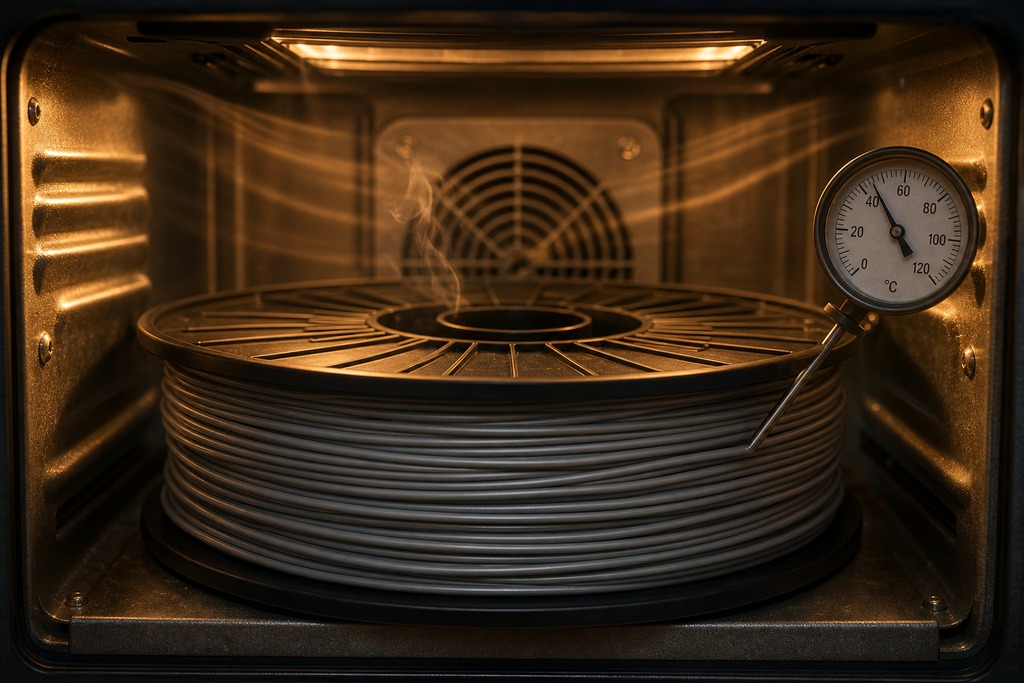
The second lever is time, driven by how hygroscopic, how moisture-hungry, the material is. Ranked from thirstiest down: nylon absorbs water within hours; TPU, PC, and PVA are very high; PETG, ABS, and ASA are moderate; PLA is the least absorbent common filament but still benefits from a cycle. Thirstier plastics need more hours, not more degrees. That's the whole reason nylon runs 8 to 24 hours while PETG is done in 4 to 8. And heat alone won't finish the job: the moisture has to physically leave the chamber, so a dryer with a fan clears water far faster than a sealed hot box, where the evaporated water just re-condenses on the spool.
Cautions by Material Group
Filaments split into three groups by how they fail in a dryer, and each group needs its own guardrail. The low-temp group (PLA, TPU, and PVA) punishes overheating: push past their limits and the filament softens and welds to itself on the spool. PVA turns to sticky gel, and TPU can suffer a permanent structural change that leaves it stiff and brittle instead of flexible. Cap PLA near 50 °C, TPU near 60 °C, and PVA at 55 °C.
The engineering group (ABS, ASA, nylon, and PC) needs sustained higher heat to drive moisture out of a denser polymer. If your dryer can't reach 70 °C, don't give up. Drop the temperature and stretch the time: ABS at 60 °C for 8–10 hours pulls out nearly as much water as 70 °C for 5. Composites are the exception that borrows from both. For carbon- or glass-filled filament, use the low end of the base material's temperature but add 1.5 to 2 times the hours, because the embedded fibers trap moisture the surrounding polymer would otherwise release quickly.
Signs Your Filament Needs Drying
Wet filament announces itself at the nozzle: popping, steam, stringing, and a rough surface are the tells. Watch and listen for:
- Popping, crackling, or hissing during extrusion (water flashing to steam)
- Visible steam, bubbles, or foamy extrusion at the nozzle
- Excessive stringing and oozing between travel moves
- A rough, bumpy, or foggy/matte surface where it should be smooth
- Weak layer adhesion and parts that snap cleanly along layer lines
- Inconsistent flow or under-extrusion
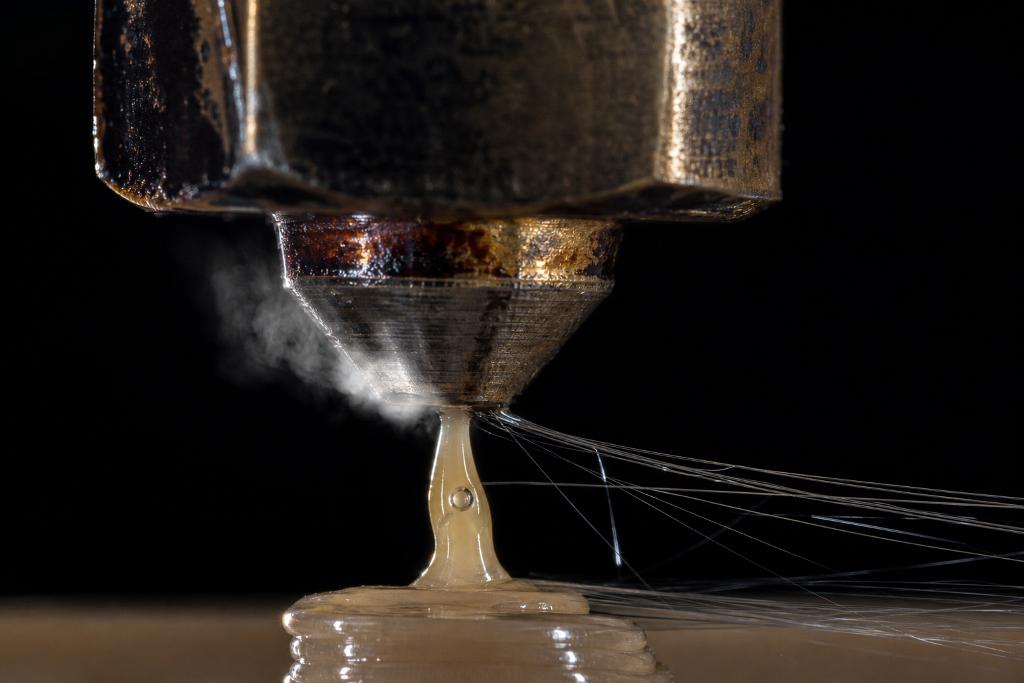
One honest caveat: none of these symptoms proves moisture on its own. Stringing can come from too hot a nozzle or too little retraction; weak layers can come from underheating or low flow. Wet filament is the likeliest cause when several signs show up together on material that's been out of a sealed bag for weeks: but rule out your temperature and retraction settings before you blame the water.
Keeping Filament Dry After the Cycle
Drying is temporary: a dried spool starts reabsorbing water the moment it meets humid air, so storage is half the job, and it's the part most people skip. A freshly dried nylon roll left on an open shelf can be measurably wet again within hours; PLA has days. The fix: seal the spool in an airtight container or vacuum bag with fresh silica-gel desiccant, aiming for low relative humidity — under roughly 15–20% for the hygroscopic materials. Let the spool cool inside the sealed container before you open it to room air, because a warm spool pulls moisture in fast as it cools.
For the thirstiest filaments (nylon, PC, PVA, and some TPU) the cleanest approach is to skip storage between drying and printing entirely: feed straight from a heated dryer or dry box while the print runs, so the material never sits in open air. When your desiccant beads change color to signal saturation, don't toss them — bake them at about 120 °C for 1–2 hours to drive the water back off, then reuse them. Remember what desiccant does and doesn't do: it maintains dryness in a sealed box, but it won't rescue an already-saturated spool. That still needs a full drying cycle.
Dryers, Ovens, and Spool Limits
A dedicated dryer with active airflow beats a static heated box because the moving air carries evaporated moisture out instead of letting it settle back onto the spool. Most consumer units map their presets to roughly PLA 45–50 °C, PETG/ABS 60–65 °C, TPU 50–55 °C, and nylon/PC around 70 °C — and 70 °C is the hard ceiling on many of them. Models that let you print while drying, so hygroscopic filament never sees open air, include the Sunlu S2 and S4, Creality Space Pi, Bambu Lab AMS, and the Polymaker PolyDryer.
A kitchen oven is a risky fallback, not a first choice. Household ovens control low temperatures poorly and tend to overshoot enough to soften PLA or warp a spool before you notice. If it's all you have, use the lowest setting, prop the door slightly ajar to vent moisture, and check the real chamber temperature with a standalone oven thermometer — never trust the dial. Watch the spool's own heat rating, too: cardboard, polystyrene, and some reusable plastic spools can warp before the filament reaches its target temperature. The heated-print-bed-under-a-box method (spool on the bed, cardboard box over it, bed set to the drying temperature) works as a last resort but needs close monitoring, since the bed heats unevenly.
Who Should Not Rely on a Consumer Dryer
A consumer dryer that tops out near 70 °C cannot properly dry polycarbonate, heavily saturated high-temp nylon, or PEEK — for those the honest answer is "not with that unit." You need a higher-temperature dryer or a convection oven you've verified with a thermometer. Anyone hoping to dry PLA and nylon in the same cycle should also stop: there's no shared setting that works, because PLA's 50 °C ceiling under-dries the nylon while nylon's 80 °C temperature deforms the PLA. Run them separately.
Anyone treating a drying session as permanent is setting up the next failed print. Without sealed desiccant storage, the filament is wet again within hours to days, so a single "I dried it once" doesn't hold. And anyone reaching for the oven without a standalone thermometer is gambling a spool on a dial that's often off by 10–20 °C — the overshoot that ruins PLA is exactly what oven dials hide. Finally, if a spool's material is rated below your target drying temperature, don't dry it at that temperature at all. Drop to the highest safe value the spool tolerates and extend the time.
FAQ
Will PETG dry at 45 °C?
Not well — 45 °C sits below PETG's effective range of 50–65 °C, so it's too cool to drive moisture out of the polymer at a useful rate. It may slowly shed surface dampness over many hours, but it won't fully dry a saturated spool. Use 55–60 °C instead; PETG's softening point leaves plenty of room.
Can you overdry a filament?
Running longer at the correct temperature is generally low-risk — the "when in doubt, dry it" rule holds. The real damage comes from too much heat, not too much time: overheating deforms spools and can permanently harm materials. TPU and other flexibles are the exception, where excess heat, even over a normal duration, can leave them stiff and brittle for good.
Can I dry PLA at 50 °C?
Yes, but it's the top edge of PLA's safe range, since PLA starts softening around 55–60 °C. At 50 °C, keep the cycle to 4–6 hours and check the spool for any sag or layers sticking together. If you want more margin, 45 °C is the safer choice and dries PLA nearly as well.
Can I dry PETG and PLA at the same time?
It's not ideal, because their temperature ceilings don't overlap cleanly. Either cap the dryer at PLA's 45–50 °C and accept that the PETG dries slowly (extend the time well past its normal window), or dry them in separate cycles. What you must not do is run PETG's 60 °C temperature with the PLA inside — that will soften and warp the PLA.
References
- Filament manufacturer datasheets and drying guides: Prusament, Polymaker, Bambu Lab, eSun
- Filament dryer product documentation: Sunlu S2/S4, Creality Space Pi, Polymaker PolyDryer, Eibos, PrintDry
- Slicer documentation covering moisture and drying (Bambu Studio, PrusaSlicer, Cura)
- Community torture tests comparing wet versus dried filament across PLA, PETG, nylon, and TPU